1/02/2015

The Crossing of the Guianas – Part 3 (Across French Guiana and back into Brazil)


The story of the French convict Henri Charrière, better known as ‘Papillion’, is an exciting tale (which, although meant to be true, is apparently largely invented by Charrière himself) of survival and eventual escape from the infamous Devil’s Island. The film version of his autobiography starring Steve McQueen and Dustin Hoffman is definitely one of my favourites. It was only whilst planning my travel through the Guianas a few months ago that I realised that the former penal colony on the Îles du Salut (the ‘Islands of Salvation’ in English), which Devil’s Island forms part of, is located off the coast in French Guiana. Visiting these islands became the one main thing I wanted to do when backpacking across the last European colony in South America.


I was fully aware whilst crossing the Maroni (Marowijne) River by ferryboat from Suriname to French Guiana (which the French themselves call ‘Guyane’) that I had to find ways of cutting my costs during this part of the travel. Transport is expensive and the cost of accommodation ridiculously high – especially in Cayenne, the capital of this French overseas territory. My first cunning plan to cut costs was to try to find a car ride from one of the other passengers on the ferry: in order to get from the French immigration office in St. Laurent du Moroni to the town of Kourou. There were two things of interest for me in Kourou: hopping onto a boat heading to the Îles du Salut and visiting the Guiana Space Centre which is a few kilometres outside the town.

Arriving in St. Laurent du Maroni

Whilst waiting in the queue at the immigration office on the Surinamese side of the river, I had started chatting to a Dutch man who was part of a golfing delegation. His team of Surinamese golfers were heading to Kourou in a few large cars in order to challenge a team from French Guiana. “Bingo!” I thought. “I just got my first ride”. 

The golfer I befriended talked to me about his childhood, spent between the Netherlands and Suriname (he has dual nationality). He used to spend much time in the Surinamese border town of Albina as a child and, at times, his dad would take him by boat to the other side of the river to visit the former penal colonies there. He mentioned that the French also kept persons affected with leprosy on a small island in the middle of the Maroni River. So much for their human rights! I was tempted to remain in St. Laurent for the night but was aware that I’d get my fair share of historical prisons at the Îles du Salut so I might as well press forward and reach my targeted destination. Moreover, I didn’t want to lose out on the chance to get a free ride with the golfers. Whilst on the ferryboat, I really tried my best to charm the guys with tales from my travels and thought that the lift was a sure win.
 
Immigration formalities on the French side of the river were straight forward. They stamped the entrance on my passport and welcomed me to the territory. It was strange to switch to the French language all of a sudden and see the French flag flying at the port. When I got to the cars of the golfers, I got a nasty surprise. All vans were full and nobody was willing to shift their belongings by an inch to make space for a hitchhiker. It seemed particularly easy to make space in one of the cars but the golfer’s obviously rich wife could not be bothered to lift a finger, or allow me to lift a finger. “Can’t you see there’s no space?” she asked with an arrogant tone. All I could see were a couple of suitcases that I could have easily shifted to a different position before hopping into the car. I obviously didn’t argue with her – so here went my first lift. I tried to hitch a ride with some other cars but none stopped. It dawned on me that I may have to simply catch public transport on this part of the route. Vans take you from St. Laurent to Cayenne for 40 Euros but can drop you off at Kourou for 25 Euros. I eventually heard that my friends, Debbie and James, fared better with hitchhiking on this part of the route. Not only did they get a ride, but the friendly persons who picked them up actually invited them for food at their home! So hitchhiking is a feasible option here.

The French flag flying proudly

It was already past midday and I wanted to, at least, save myself the cost of sleeping in a hotel that night. The most expensive thing about travelling through French Guiana is accommodation in the cities. When looking around online, the cheapest accommodation I could find in Kourou and Cayenne was approximately 55 Euros for a single room. In rural areas, you can generally sleep on hammocks for a cheap price. At this point, I faced the option of trying to hitchhike and arriving late to Kourou, thus risking the need of a hotel, or catching the van and having enough time to find a spot to camp for free before darkness falls. I had been told that Kourou isn’t the safest place on earth, so stumbling around town after dark for a place to camp was not something I wanted to put myself through. After a few more failed attempts to hitch a ride from passing cars, I asked around for the van in my rusty French and eventually found it with the help of a bearded Chilean backpacker. I paid 25 Euros (feeling the sting of hitchhiking defeat) and was eventually dropped off in Kourou a couple of hours later.

As we approached the town, I was eagerly looking for a natural spot to camp in or at least sleep outside in my sleeping bag, away from prying eyes. Nevertheless, the best fields were too far from the town centre to be practicable options since the town is quite spread out. I eventually hopped off close to a sign that pointed to a departure point for boats heading to the Îles du Salut. I reckoned that I could sleep in that area and then try to get on a boat early the following morning. The main issue to keep in mind about picking a spot to sleep in the rough (especially in an urban area) is safety. I’ve been doing this kind of thing for the past 18 years or so and the main factor I always consider when picking my spot is: no one must see me and no one must stumble over me by coincidence whilst I’m asleep. Though I do tend to sleep with one eye open in such circumstances, you can never be too sure that you won’t get surprised by someone who creeps up on you as you sleep. But if no one knows you’re there in the first place, cannot see you, and you’re in a place where people are not going to be crossing through during the night, then you’ll be fine. 

Looking for a spot to sleep near the pier

It is also important to carefully choose the area or neighbourhood where you plan to spend the night: sleeping outside in a socially problematic area increases the risk that, if someone does find you, they may consider robbing you. In a peaceful neighbourhood, just because someone may find you asleep outside doesn’t mean you’ll come to any harm (though it’s advisable to avoid being found anyway). At most you may frighten them! The darkness may be scary to many people but, when sleeping out in the rough, it’s a great ally. The darkness covers you like a blanket so I never let myself fall asleep until there’s total darkness and cannot be seen. I always like to wake up and leave my sleeping spot just before sunrise – before my magical cover of darkness disappears. I generally leave no sign that I was there, especially if I plan to sleep outside in the same area once again the following night. With these principles in mind, I looked for my spot for the night.
 
The town of Kourou seemed really quiet, with a lot of greenery amongst the wide roads and very unremarkable detached houses that lined them. I walked down the road leading to a river and realised that I was entering a rather poor area. It was a Friday afternoon but most things seemed closed and not too many people roamed the streets. I finally got to a little wooden pier close to a sign stating ‘tourist information’ – but found no information at all. I tried to ask the few people in the vicinity if they had any idea about the departure of boats for the islands and one drunk-looking man man told me that I should return there very early the following morning, when there were generally people selling tickets. I wasn’t sure of the veracity of the information given by this inebriated fellow, but it was the best I could get. 

I then switched my focus to finding a place where to camp for the night but, despite the amount of greenery around, I located no spot hidden enough to make me feel safe. Indeed, I had read that the larger towns in French Guiana can be unsafe at night and this area of Kourou didn’t seem the safest. As I was looking around, I met Helene, a middle-aged woman who I initially thought was a local. As we started chatting in French, I discovered that she was actually a tourist from mainland France who was also looking for information about boats going to the islands (and she too was told to return early the following morning). I told her about my intention to camp outside in the area that night but she warned me that a police officer had informed her that this particular neighbourhood should be avoided it at night. This was a helpful piece of information since it confirmed my worries about sleeping outside near the boat departure area.

Helene told me that she was staying at a little hostel by the sea about three or four kilometres away where people could sleep on a hammock for seven Euros per night (no such place had come up when I was looking for budget accommodation online). This isn’t cheap for hammock space by normal standards – but for French Guiana (and Kourou in particular), this was a great opportunity. More than the need to sleep comfortably, I was more concerned about finding a safe spot where to spend the night peacefully and to leave my things whilst I roamed around town. The one main problem about going to this hostel was the fact that it was about a 30 or 40 minute walk away and Helene felt that it wouldn’t be easy for me to get there with my heavy backpack. After we parted ways, I left the area around the boat departure point (known as the Brazilian neighbourhood) and walked towards the beach, where I hoped to find a safer spot where to sleep.

The Atlantic Ocean at last!

The sandy beach lined with palm trees was really beautiful and I was delighted to finally put my feet into the Atlantic Ocean – after having started this long travel from the Pacific Ocean approximately two months before. Both Georgetown and Paramaribo are very close to the ocean, but both are actually built along rivers leading to the sea itself. Therefore, this was the first time I was actually standing by the Atlantic Ocean since I had started the travel. There were a number of people walking or jogging next to the sea so I still didn’t find my hidden spot for camping. I slowly walked up the beach for a couple of kilometres with all belongings in order to scout for a camping spot – until I realised that I must be close to the hostel mentioned by Helene. She had told me to look out for an area called the ‘Village Indien’ if I decided to look for the hostel. I asked a couple of locals if they knew where the neighbourhood was and realised that I was indeed really close.

Walking up the beach towards the Village Indien
Finding the ‘hostel’ itself wasn’t so easy since it’s actually just a little wooden house that looks like any other house in the neighbourhood. This house simply has a space at the back where they have an enclosure in which you can hang a hammock. The neighbours indicated the door which I had to knock on so I went ahead and asked the chubby friendly lady who answered the door if I could camp in her backyard. I eventually noticed that there was a little sign outside the door – which was not so big or clearly noticeable – that indicated that this modest house was actually some kind of hostel. The sun was setting by the time I reached my accommodation for the night so there wasn’t much time to do anything else for the day. I would have loved to visit the Space Centre whilst I was in Kourou but it was going to be closed for most of the weekend and there are no free guided tours on Saturdays and Sundays, which are the highlight of any visit. I guess the timing was unfortunate but I was happy to, at least, have the chance to reach the Îles du Salut if only I managed to find space of a boat heading there. It’s best to book a place on a boat beforehand (especially at weekends) but I had no idea how to do this, not having either any phone number to call or a phone. I reckoned I would try my luck the following morning. 

The prison islands on the lovely horizon

That evening, Helene returned to the hostel and was glad to find me there. She had bought some French baguettes, Camembert cheese and delicious chocolate which she shared with me. We chatted for a while in French, though my level of spoken French isn’tt so good despite the fact that I’d studied the language for five years at school. I can read and write rather well but I never got my ear around understanding the French accent – especially when spoken by French people (I fare much better understanding the accents of Francophone African people). Helene, a nurse by profession, was visiting a friend who worked in the jungle of French Guiana and was heading down there in a few days. Nevertheless, she first wanted to visit the prison islands and the Space Centre. I really wished to visit French Guiana’s jungle too, which is apparently one of the most untouched jungles in South America since it wasn’t exploited much by the French. However, having spent much time in the jungle elsewhere, where it is far easier and cheaper to access, I decided to limit myself to Kourou and Cayenne on this travel. 

Camping amongst the palm trees
Sunset on the beach in Kourou

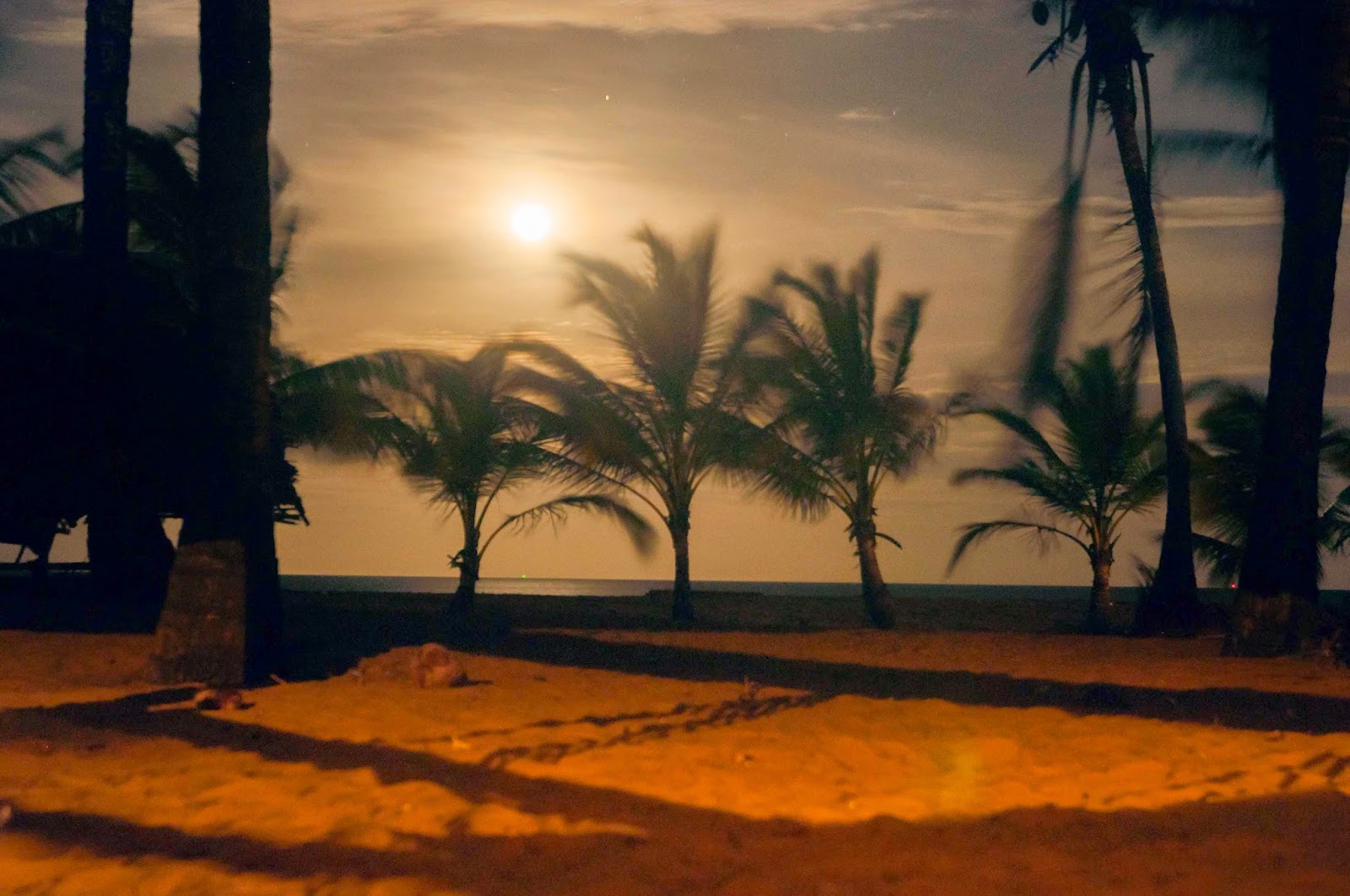
That night, I slept on the floor in my sleeping bag next to Helene’s hammock since I had no hammock of my own (I had given mine to my girlfriend, Sofia, who was crossing the Amazon on a cargo ship whilst I was crossing the Guianas). We were amongst the palm trees right next to the long sandy beach and we could see the prison islands on the horizon. After a stunning sunset, the stars shone brightly over this lovely part of the world. It’s a pity that Kourou wasn’t built in a more attractive and welcoming fashion. As the access point to two of the main attractions in French Guiana and with an amazing beach which goes on for a few kilometres, this town could really do more to welcome tourism. 
 
On the beach under the moonlight

The following morning, I got up really early and walked back to the area where the boats heading to the Îles du Salut were meant to leave from. The place I took to be the ticket office was shut but I saw a few people standing around so I suspected that it would open sooner or later. On a bench in a little park were two youngsters sleeping next to their backpacks. I sat down near them and we eventually started to chat once they woke up. They were also waiting to visit the islands and had slept in the garden in front of the ticket office after having been to a small reggae concert in the neighbourhood the night before. I guess the area wasn’t as dangerous as the policeman had warned Helene … or perhaps the two youngsters had just got lucky. 
 
The guys, Esteban and Mikael, wanted to practice their English so they spared me from blabbering away in my awful French. They are both from mainland France but are studying in Cayenne. Esteban had already been here as a child and recalled visiting the islands as a special memory from his childhood. He wished to relive these memories, he said. We wondered if we were in the right place to get tickets since everything remained closed even after 7am. Nevertheless, more people started gathering around as the time approached 8am. My main worry was that, being a Saturday, the boat might already be fully booked. Once the ticket booth did open, my fears were confirmed. The boat leaving at 9am was fully booked but there were a few places left for the 11am boat. Nevertheless, the man at the booth recommended that we wait till 9am in case some people don’t turn up for the boat. Indeed his suggestion was fruitful: we all got lucky and made it to the earlier boat, which was great since I would otherwise have had very little time on the islands till the boat returned that same afternoon. Therefore, I paid the (rather expensive) return ticket of the boat and entrance to the island (a total of 42 Euros) and off we went on this magnificent catamaran towards Île Royale, the only island of the three which one can visit on such excursions. 

The catamaran going to the Iles du Salut

People can camp on Île Royale for free and I did seriously consider this option. The problem was that I wouldn’t have been able to return the following day (a Sunday) since all boats were fully booked. I therefore would have had to spend two days and two nights on the island but didn’t have enough food with me to last that long. Buying food on the island itself would have been too expensive to consider. I therefore decided to return to Kourou that same afternoon since there was place on the boat returning at about 4.30pm. Loving the sea with a passion, it was great to sit in the front of the catamaran as it sped gracefully towards the islands – which are about 14 km from Kourou.

Sailing to the islands

As the boat approached the islands, I tried to imagine that I was a convict reaching my destination of prolonged detention several decades ago. These islands were used as a penal colony for those considered as the worst criminals in France from 1852 until as recently as 1953. I was struck by the natural beauty of the islands so it was hard to feel any dread – until I saw the prison buildings and recalled the hellish paradise depicted so well in the classic film starring Steve McQueen. The sun washed colours were just as I recalled them in the film. As the passengers hopped off the catamaran, my new French friends told me they were going to find a spot where to swim but I was really eager to explore what remains of the prisons. I promised them that I would catch up later. Île Royale is the largest of the three Îles du Salut, but is still small enough to find somebody along the shores if you walk around for a short while.

Approaching the gorgeous former penal colonies
The sun-washed colours of the tropical island

I spent a few hours roaming around the ruins of on Île Royale and visiting the small museum which was once the Prison Director’s house. I learnt about the famous prisoners who were kept on the islands, especially the political prisoner Alfred Dreyfus who was detained on Devil’s Island between 1895 and 1899 for treason. A number of prisoners tried daring escapes throughout the years, and some succeeding to defy the powerful currents on more than once occasion to escape from the prisons which were considered inescapable. The famous Henri Charrière, though, was probably a fraud and the stories he claimed to be his own possibly actually happened to some of his fellow inmates. Apparently, he was also not as innocent of the crime he was convicted for as he claims in his autobiography – there seems to have been a lot of evidence that he did commit the murder that sent him to the island penal colony. Having spent so many years of my own life working with detainees in sub-standard and overcrowded detention centres, the stories of suffering that I came across here in the Îles du Salut particularly struck me. Humans do tend to dehumanise others with too much ease. More worryingly, some of the convicts here were only guilty of diverging political opinions from the status quo.

What were once treacherous prisons
The museum in the Director's House
Paradise or hell? The infamous Devil's Island

Whilst exploring the tropical island, I saw a few monkeys playing in the trees. At one point, I was forced to take cover under some of the ruins as a massive rain storm crashed over the island for about half an hour. I eventually climbed to one of the high points of the island and saw the infamous Devil’s Island beneath me. This is where the political prisoners were held. It was meant to be the most difficult of the islands to escape from due to the powerful currents between it and the other islands. I got a small taste of these currents as I swam for a while with my French friends. Esteban rested in a hammock hung between two palm trees whilst Mikael carved out some coconuts that had fallen from the trees above. I eventually said goodbye to the French guys and headed back to the little port from where the catamaran took me back to Kourou. That night, I once again slept in my sleeping bag next to the beach. Helene had gone to the Space Centre that day but couldn’t find any tickets for the Îles du Salut the following day despite trying to book beforehand. I suppose that Sunday isn’t the best day to simply turn up and hope to get to the islands.

Inhabitants of the islands
The lighthouse behind some palm trees
Not everyone made it out alive

I was soon to find out that Sunday is not a good day to many other things in French Guiana. My plan was to get to Cayenne as early as possible in order to explore the capital of the territory before trying to figure out how to get Saint-Georges, at the border with Brazil. I was up very early the following morning and took all my belongings to the centre of town, where I hoped to get on a van heading to Cayenne. Nevertheless, after spending a couple of hours waiting, I realised that there may be no public transport working on a Sunday. Some people passing by confirmed that no vans may come at all. I therefore only had the option of hitch hiking. I walked to the main road heading out of town and stuck my thumb out as I walked. Nobody stopped so I kept on walking. Several large fancy cars passed by but few even gave me a second look. Some made me apologetic signs which I didn’t understand and a few made what seemed to be angry signs, as if I should not have been there disturbing their existence in the first place.
 
The towns of French Guiana along the highway

I was almost out of the town and onto the highway when an old battered white car stopped. A charming young man gave me a smile and told me to hop on. He was a Brazilian person working in a natural reserve in French Guiana. No wonder he was so friendly! Unfortunately, he could only take me a part of the way to Cayenne since he had to get to his workplace but it was better than nothing and gave me the morale boost I needed to believe that people would actually stop for me. Nevertheless, after that I remained a very long time in the middle of nowhere waiting for my next ride. One – perhaps two – hours passed and no one else stopped. I guess there were no more Brazilians around. Was it because it was a Sunday? Was it my looks? I wondered why no one was stopping as several large cars with arrogant looking French people inside zoomed by. Many things passed through my mind as more cars sped by without stopping. I wondered if I would even reach Cayenne by that night and how many days I would need to eventually get to Belem in Brazil, where I had to meet Sofia.

10am on a Sunday. The blazing sun was beating down over me. My thumb was up but my morale was down. I had started my day at about 6am and 4 hours later I was barely a fourth of the way to Cayenne. Would anyone else stop? I had to believe it but with every car that passed, my belief diminished. Hitchhiking is like fishing – you wait and wait and sometimes you get lucky, sometimes you must wait ages to catch a fish and at times you catch nothing at all. You need time when hitchhiking – time and patience. Just when I was really starting to believe that nobody else would stop, an elderly French man slowed his car down to a halt. I was so happy! Finally a French person had stopped for me. My happiness was short-lived though, as he had to leave the highway after about 10km and couldn’t take me any further. I barely gained much ground with that ride but at least it was another morale booster of sorts. About another hour passed until I hit an unlikely jackpot. An angry looking man of African origin stopped his shabby dark blue car next to me. He asked where I was going. “Cayenne!” I said. He mumbled something and told me to get in the car. I did, but was half worried – given his aggressive expression – that he’d take me to some abandoned area and beat me up. To reassure myself, I started to chat with the guy and he turned out to be the nicest person – he just had a rough way about him. He, too, was not a local but was a migrant from the far off African country of Guinea Bissau. He told me that French Guiana was a good place for him to find work, though how he arrived to this far off land I never discovered. 

This time, we went all the way to Cayenne, stopping on the outskirts for the kind driver to pick up some groceries. I noticed a lot of poor looking people playing cards outside the shop. Some looked at me in a strange way. My African friend eventually returned to the car and asked me where I wanted to go. “The centre,” I replied. “I’d like to get to Saint-Georges at some point” I added. My new friend mumbled something and took me to a spot where shared taxis leave for the border town. He dropped me off there and I thanked him for his kindness. He mumbled a reply and drove off. This man had been so helpful and benevolent despite his rough ways – a real lesson not to judge people by their way of expressing themselves. It was early afternoon by the time I arrived to Cayenne and I saw a couple of shared taxis that were waiting to fill up before heading to the border with Brazil. I decided to walk around Cayenne for a while to at least visit the centre of town before leaving.

Colonial houses of Cayenne

I would have gladly spent the night in Cayenne but my attempts at couch-surfing failed miserably. I had written to about 15 different people with what I thought was a really nice introduction but only one girl replied, telling me that she was sorry but she was about to move apartment that same week and could not host me. A Spanish couch-surfer I met on a cargo ship in the Amazon had told me that she invents such excuses when she doesn’t want to host someone. I wasn’t sure if my lack of success at couch-surfing in Cayenne boiled down to the fact that I had requested a place to stay at too late before my arrival, or if it was because I had no recommendations being new to couch surfing. It may have also been due to the fact that I am male and 37 years old. The point was that I had no access to free accommodation and that hotels in Cayenne charge ridiculously high prices. Hence my mind was made up to simply walk around the centre and then leave for Saint-Georges that same afternoon.

A church in Cayenne

Cayenne struck me as nothing really special. The architecture was rather bland and I suspect that this town would not attract any attention if it happened to be anywhere in mainland France. I admit that I didn’t spend enough time in town to really make a good judgement. Also, being a Sunday there was hardly any activity in town so I was not seeing the town at its best. I did like Place des Palmistes (a square full of palm trees) and a few colonial houses next to the coast. On the whole, I much preferred Kourou which at least has a lovely beach if nothing else.

Place des Palmistes

After my stroll around Cayenne, I went back to the corner a few blocks from Place des Palmistes where the shared taxis towards the Brazilian border left from. One could try to hitchhike to Saint- Georges and Esteban told me that he had managed to do so successfully. Nevertheless, he himself admitted that he met a policeman who had heard some bad stories of people being robbed and abandoned with nothing left along the isolated road heading there. I wasn’t sure I wanted to take the risk and I was looking forward to head on to Brazil as soon as possible. I still had my mind set on reaching Patagonia by January – so time was running out for me to cross through and explore Brazil, being already the second week of November at that point. I also wanted to be in Belem by three or four days later since Sofia was meant to arrive there more or less by that time after crossing the Amazon by boat from Manaus.

The two-hour van ride to the border was rather smooth and passed through some admittedly isolated stretches of jungle road. Once we arrived to the beautiful Oyapock River, I was told that I didn’t need to stamp my passport out of the country, being a European Union citizen. I just needed to hop onto a little boat that would ferry me a couple of kilometres down the river to the Brazilian border town of Oiapoque. The boat passed under an unused bridge – the first bridge connecting Brazil to the European Union. The bridge seemed to be rather complete to me but apparently it hadn’t opened to the public yet. It was meant to be ready by the World Cup but somehow the plan didn’t work out that way. I wonder if they were expecting crowds of people to come down this route overland from the Guianas into Brazil for the football tournament!

The boat waiting to take passengers to Brazil
A bridge between Brazil and Europe
The beautiful Oyapock River

I was eventually glad to get back to Brazil, where the people are so much friendlier than in the French territory despite being poorer and everything is so much more affordable. Close to the riverside in Oiapoque, where the boat dropped me off, I bought a bus ticket to the city of Macapa with my last few Reales (the ticket cost 90 Reales). I barely had a handful of Reales left after that. I then walked a couple of kilometres to the immigration office to get an entry stamp into Brazil. I told them I would be needing about a month and a half in the country and was duly given 45 days by the officer in charge. 

View from the Brazilian border town of Oiapoque
 
I then went to find a bank to save my financial situation. I found two banks but none of the ATMs gave me any cash. I had some US Dollars and Euros I could change but barely enough Reales to buy a cup of coffee. With that, I walked a few kilometres to the bus terminal. I had enough time to get there to catch my bus despite the distance and the weight I was carrying since the bus was leaving in the late afternoon. When the time came, I hopped onto my bus and headed towards Macapa with the plan of getting a boat to Belem – but first I had to find a bank that would allow me to withdraw money. I smiled as the bus scurried south along the bumpy road. The nature was beautiful all around, despite too much human intervention on the land. I hoped that the extensive human settlements were limited to the areas around the roads – though Brazil isn’t historically known for land conservation and sustainability. Bump after bump, I set off to discover this land I have dreamt of since I was a little child, wondering if I’d be dazzled or disappointed by South America’s largest country – but with already much love for Brazil and its incredibly friendly people.


12/28/2014

The Crossing of the Guianas – Part 2 (Georgetown and on to Suriname)


“In Georgetown, thieves first stab you and then check to see if you have anything valuable!” That’s what my Japanese boxing champion friend Motoki had to say about Georgetown whilst we were trekking together in Venezuela. I imagined a pile of bloodied bodies randomly lying around the streets of the Guyanese capital. More recently, George, my delightful host in the Guyanese village of Nappi, also had stern warnings about Georgetown. “Don’t walk about the streets alone, day or night!” he cautioned. He feels that the high level of violence in the capital is a major cause for so many people to migrate from the country. With these visions of doom, I set off on a long van ride from the border town of Lethem, in the southwest of Guyana, towards the capital of the country, Georgetown, up north along the Caribbean coast.

The savannah and hills around Lethem

It was soon after 6pm when the rickety van stuffed with people left from Lethem. I was told that we should be arriving in Georgetown at about midday the following day. It was already getting dark by then and I was sleepy but fully aware that I wasn’t going to get much sleep that night due to the crammed and uncomfortable space I was in. I was sharing a little two-seat bench with a very overweight Brazilian man who needed more than a seat and a half just for himself. I therefore struggled to remain on my own seat – a constant battle to nudge as much of my buttocks onto something solid and avoid falling on the floor. Under normal circumstances, I can still imagine the ride being rather rough. For the equivalent of approximately 60 US dollars (12,000 Guyanese Dollars) per person for the travel, you’d expect a more comfortable means of transport. But then again, those are the prices in Guyana.

Savannah and giant termite mounds

Until the light of day faded, I enjoyed looking through the window as the van sped along the dirt road through the dusty savannah and eventually into the jungle. I had been told that the road is very bumpy but I must admit that I was expecting worse. There’s no tarmac yet in this part of the country – despite the fact that this road is a vital link between Brazil and the Guyanese capital – but in truth it wasn’t as bad as I had expected for much of the route. I think the road must have been flattened recently, though some parts still did have large holes all around – which our driver seemed to drive into on purpose. In particular, he seemed to love speeding through the deepest puddles instead of slowing down. My guess is that the road will deteriorate again after the rainy season, until the government eventually decides to actually tarmac the road. As the van entered the jungle, I could no longer see anything due to the darkness. 


Sunset along the road

The van eventually stopped near a little wooden restaurant for supper at about 9pm but all food options seemed a little bit too expensive for my budget. We eventually stopped again about 30 minutes further down the road near the entrance of the Iwokrama Natural Reserve, which was closed for the night, and we slept in a wooden structure nearby for a few hours where you can rent out a hammock for a cheap price. I paid nothing since I simply rolled out my sleeping bag and slept on the floor (though in hindsight it may not have been a great idea due to the creatures crawling around the jungle). By about 4am, we were up again and on our way to cross through the natural reserve as soon as it opens. I’d have loved to stop in Iwokrama to walk along the roof canopy that passes over the jungle. Nevertheless, it would have been an expensive affair since you’d have to buy two full tickets from Lethem to Georgetown for a start, then pay the entrance to the park and sort out accommodation. It just felt a bit too complicated (and expensive) for my liking so I decided against this option. We were thoroughly checked by police officers assigned to protecting the natural reserve before the van entered its territory.

The dirt-road leading to Goergetown


The longish drive across the natural reserve made me realise how big it actually is and I longed to discover what lies within. The van eventually arrived to a river which we had to cross by ferry so the passengers got off and waited for the ferryboat to arrive. I was struck by the beauty of my surroundings in the early morning light. As the ferryboat slowly reached the riverbank, another smaller boat approached, selling breakfast to those getting on board the ferry. We had to pass through another intense police check as we left the natural reserve area, mainly aimed at avoiding persons from taking flora and fauna out of the reserve. As we headed further north, the road eventually became smoother until it became tarmacked as we were about two or three hours away from Georgetown. To my surprise, it started to rain as we were about a hundred kilometres from our destination. We eventually arrived there at about 2pm – a good 18 hours after leaving Lethem.


Ferryboat at sunrise
Breakfast directly from a boat


The outskirts of Georgetown looked somewhat like the suburbs of an English town (but with a tropical climate), an obvious effect of the British colonial era. I also noticed some Hindu temples every now and then. The centre of Georgetown doesn’t have any high-rise buildings and, being a Sunday, it was also rather dead. It was therefore hard to realise that we had actually arrived in the centre itself. My plan was to stay at the YWCA Hostel, which is apparently the only reasonably priced lodging in town (at 2000 G$ per night for a dorm bed). Due to the many stories I had heard and read about the dangers in Georgetown and not having an idea where I was when the van dropped me off, I decided to catch a taxi to the hostel. After waiting for a short while due to the lack of taxis driving around on a Sunday, I finally managed to stop a taxi that wasn’t already occupied. The YWCA Hostel turned out to be rather close from where the van had dropped us off but I still got charged a good 700 G$ by the taxi driver (I was told a fair price would be around 300 G$). My ‘pleasant’ surprises were not over yet: the YWCA Hostel apparently doesn’t function on weekends and there I was outside its door on a Sunday afternoon. What kind of a hostel doesn’t work on weekends? This tiny detail wasn’t mentioned in the Lonely Planet recommendation! 

White-painted wooden houses in Georgetown
A Church on the outskirts of the city


I found myself in the middle of the wide deserted roads of Georgetown with all my belongings and no idea what to do or where to go. The taxi that had brought me there had long gone by the time I realised that I needed to find somewhere else to stay at. Thankfully, I had jotted down another address of a guesthouse (the ‘Rima Guesthouse’ in Middle Street) which was much more expensive but at least provided me with a reference point. I usually just turn up in most cities and find the first cheap hotel or hostel that I come across. Nevertheless, Georgetown isn’t brimming with hotels of any sort, let alone budget accommodation. It’s therefore best to arrive with an idea of where you’re going to sleep (and a back-up plan too). At this point, I figured that I had very few options since nothing would be cheap here anyway. I had no option but to stay in Georgetown for a couple of nights in order to sort out the formalities necessary for entering into Suriname. I therefore considered that the high price of accommodation I’ll incur will fall under the fixed costs of this part of my travel. I tried to find another taxi to take me to Middle Street but none were passing from where I was standing. I therefore started to slowly walk towards an area of town which seemed to be the city centre. At this point, I kept on thinking of the dire warnings that my friends had given me about walking alone in this city but I felt somewhat safer seeing that the streets seemed devoid of other people – both good or bad. After about 15 minutes, I finally managed to flag down a taxi that took me to the Rima Guesthouse for another 500 G$.

Thankfully, the quaint little guesthouse within an old colonial building was open and seemed like a really pleasant place to stay at. It also had an excellent Wi-Fi connection. I booked for two nights and settled down in my room, which cost me 6000 G$ per night. The price would have been much more worthwhile had I been travelling with another person since a double room only cost a little bit more. Feeling tired from the long journey and somewhat intimidated by Georgetown’s reputation (aggravated by the empty streets on a Sunday), I simply stayed in my comfy room till the following morning. To spice up my Sunday evening, my girlfriend Sofia (who was meant to have arrived in Manaus and eventually reach Belem along the Amazon River) hadn’t sent me an email since we parted ways in Boa Vista five days before. I therefore feared that she had disappeared like the young woman in the creepy movie ‘The Vanishing’. I slept feeling guilty that I had sent her backpacking on her own when she had never done anything of the sort before.


The townhall in Georgetown


The following morning, I woke up feeling fresh and eager to sort out the Surinamese formalities. Citizens of most EU countries only need a tourist card to enter Suriname whilst a visa is needed for persons from other countries (be sure to check online if you’ll need a tourist card or a visa). Either way, one must head to the Surinamese Embassy in Georgetown in the morning and fulfil the bureaucratic formalities before heading to the neighbouring country. I spoke to the owner of the guesthouse that morning and asked her if it was safe to walk alone in the streets of Georgetown. She told me that it was fine and that I could reach both the city centre (which was a short walk away from the guesthouse) and the Surinamese Embassy on foot. Her reassurances made me overcome my initial fears and allowed me hit the streets of Georgetown with confidence. Indeed, it looked like a different place on a Monday morning, with shops and restaurants open, several people walking along the streets and a number of cars driving by. I got hold of a map of the city and tried to find the Surinamese Embassy, which was meant to be about a 15 minute walk away. 

A Hindu Temple near the Surinamese Embassy

After looking around for a while whilst getting myself orientated amongst the wide streets, canals and a few parks, I eventually found the embassy. I waited at the gate for the guard to open but he seemed more interested in talking on his phone. Since it was raining at the time, I opened the gate and walked in so the guard told me off. I made a half-hearted, quick apology and scurried towards a covered area of the embassy garden. It was soon my turn to talk to a Surinamese official within the building, and I found him to be very friendly and polite. I gave him my passport, 25 US Dollars in cash and the passport photos which I thought were the only requirements for a obtaining a tourist card. Actually, I didn’t need the passport photos at all but I did need photocopies (which I didn’t have) of my passport and the Guyanese entry stamp on my passport. I had either read the online information badly or was given the wrong information.
It is important to keep in mind that for the Surinamese tourist card, one must pay 25 US Dollars in cash in that particular currency – so make sure you find a way to have this with you when you’re in Georgetown since there’s no other way to pay the fee, strangely enough. Getting the necessary photocopies was easy enough, thankfully, since there’s a shop which makes photocopies just five minutes’ walk away. I was soon back at the embassy with the photocopies of my passport and the Guyanese entry stamp as required. I paid the 25 USD, gave the photocopies and left my passport with the official. I’m not sure why, but instead of giving you the tourist card on the spot, they make you come back again in the afternoon after 2pm. Why they have this time-consuming procedure is anybody’s guess – but that’s the way it is. Having said that, if you have the 25 USD, the photocopies and your passport, it’s all rather simple and just requires getting to the embassy twice within the same day. I imagine that those needing a visa would need to do a little more as procedures go and it will surely be more expensive too.

I spent the rest of the day exploring Georgetown and, in the end, I quite enjoyed it. It’s a very particular city both in terms of architecture and culture. The architecture is decisively British whilst the strong influence of both the Indian and Afro-Caribbean cultures (which are a result of the British colonial times) is very obvious, particularly in the city centre. Indian spices can be smelt at the markets, emanating from many street-vendors and restaurants.  I took advantage of these restaurants to have some tasty and authentic Indian food when I got hungry. I particularly enjoyed walking around the historic Stabroek Market, which is bustling with activity during the day. All around the market, you can hear laughter, cheerful shouts and also some angry yelling from time to time. I was told to pay attention to pick pockets here – so I did – but I still took photos and roamed around the stalls and nothing bad happened. On the whole, I felt rather safe with all the people around me going about their daily business. 

Stabroek Market in the city centre
Multi-cultural environment at the market
Selling fish at the market

There are a couple of free museums worth visiting in Georgetown: the Museum of Guyana and the smaller but quaint Walter Roth Museum of Anthropology which has a small collection of indigenous items. Both museums close rather early so one must make sure not to get there too late during the afternoon. St. George’s Cathedral is worth a look (it was closed when I was there but I admired it from the outside) since it is apparently the world’s tallest wooden building. I also took a longish walk to the Square of the Revolution in order to see the fascinating monument influenced by African art dedicated to the slaves who started a rebellion on a colonial plantation in 1763. Whilst being a bit of a walk from the main central area of the city, this monument isn’t too far from the Surinamese Embassy. Once I got used to the city, I ended up walking everywhere and never caught another taxi whilst I was in Georgetown. On the whole, I quite liked Georgetown for its gritty feel, the particular architecture and the thriving mixture of cultures in the city centre. Nevertheless, I do think that the authorities should work hard to keep the city cleaner and safer. There’s a lot of potential here that better governance could turn into a very liveable place and one which could attract more tourism. It’s also a pity that the city isn’t built to take better advantage of the waterfront, which is hardly noticeable as you roam around the city.

Monument in Square of the Revolution
St. George's Cathedral - the tallest wooden building in the world
Georgetown deserves better than this

That afternoon, I asked the guesthouse staff to arrange for a shared taxi to take me to the Surinamese capital of Paramaribo the following morning (the ‘cheapest’ – apart from hitchhiking – and easiest way to get there). The cost of the journey by van from Georgetown to Paramaribo is 6500 G$ – but one must also add the price of the ferry that crosses the Corentyne River which acts as a border between (3125 G$) which is a separate cost. The van was meant to pick me up at about 4am from the hotel – but arrived at approximately 4.30am instead – and took me and the other passengers to the Guyanese border town of Corriverton. We were dropped off there and given a sort of ticket to be shown across the river on the other side of the border. Once you cross the river by ferry, another van picks you up on the other side and all you have to do is show them this ticket in order to be taken all the way to Paramaribo. It takes a while on the Guyanese side of the border since you must wait in two long queues – one to buy the ferry ticket and the other for immigration. Whilst in one of these queues, I met Debbie and James again by coincidence. I was surprised to see them there since I had left them behind in Lethem and thought that they were staying a while longer in southern Guyana. In the end, the high prices and complications linked to travel within the country put them off and they had got a lift to Georgetown on Sunday morning. Once all immigration formalities were over on both sides of the border, I hopped onto my van on the Surinamese side of the river for the ride of a few more hours along the Caribbean coast to Paramaribo, the capital of Suriname. We eventually got there at about 4pm and the van dropped everyone off at the addresses they requested.

To the ferry at the Corentyne River
Debbie, James and I wanted to stay at a fun-looking hostel called ‘Zus and Zo’ but it was full when we got there. The helpful receptionist indicated a reasonably priced guesthouse in the area which was within walking distance. Within minutes, we were at the ‘Albergo Alberga Guesthouse’ in Lim-a-Postraat – one of the most charming streets of Paramaribo. The street is lined up with white-painted wooden houses which made me feel as if I had travelled back in time. I was given a single room which cost me 17 Euros per night (in Paramaribo, you can pay for many things in either Surinamese Dollars or Euros). I really liked the guesthouse – it has a spacious living area and actually had a little pool at the back which is perfect for the hot climate. Whilst there aren’t many budget options for accommodation in Paramaribo, this felt like true value for money. I was also happy to know that I could withdraw Euros from some of the banks in town, which could be handy further along my travel, especially in Argentina where US Dollars (preferably) or Euros can be exchanged for very good rates on the informal market. I headed off to a nearby bank to withdraw some money since I had used up all my Guyanese Dollars before crossing the border and was basically cashless. It was a relief when the ATM gave me money without problems, after I was worryingly not able to withdraw money from ATMs in the Brazilian city of Boa Vista and in Lethem.

Downtown in Paramaribo
Lovely houses in the Surinamese capital

The day of my arrival in Paramaribo happened to be my 37th birthday so I wanted to celebrate in some way or another. Thankfully, I had the company of James and Debbie so I would not spend it alone. We also met a delightful Dutch woman called Nel at the guesthouse and she told us of a little place by the river where we could get some good Javanese food for a reasonable price. To add to the fascinating cultural mix in this part of the world, there’s a minority of persons originating from the Indonesian island of Java dating back from the time when both Indonesia and Surname were Dutch colonies. We therefore headed to this restaurant and spent the evening drinking cold beer and eating delicious Asian food. My birthday had started off at 4.30am in Georgetown and ended in style several hours later by the Surname River in Paramaribo.

Monument next to the Suriname River

Nel was visiting Suriname and Guyana to do some research on a little known Dutch historical figure who she’s planning to write book about. The few things she told us about this man (he was a pirate for a while amongst other things) made me really want to read her book but unfortunately she’ll be writing it in Dutch, with no plans for an English translation. She told us about her misadventures in Georgetown, where she spent several days wasting her time due to the erratic opening hours of the library she was meant to be doing her research at. The following morning, I joined her to visit the Stichting Surinaams Museum, probably the most interesting museum in the city. This museum is based in Fort Zeelandia by the river and has a number of exhibits from the country’s history and different ethnic groups. 

Fort Zeelandia

One thing that struck me in the museum is a plaque commemorating the rather recent (1982) execution of a number of political activists and I was shocked to discover that the current president of Suriname is the very same person who had these people executed. My surprise for twofold: how does the president guilty of this massacre let the memorial remain so prominently in the museum and, even more importantly, how did the Surinamese people vote for a man guilty of such an atrocity? The Dutch government was very critical of this episode and therefore political ties are rather tense between Surname and their former colonisers – so much so that Dutch people actually need a visa to enter the country unlike most other Europeans. After visiting the museum, we entered the Roman Catholic Kathedraal, which is rather unassuming from outside but is really beautiful from the inside, with unpainted wooden carvings decorating the whole church. Walking further around the city, I was pleased to see a large mosque and synagogue stand side by side in the same street with seemingly no tension. I eventually made my way to the riverside market – a bit too late in the day to really see it at its liveliest.

Memorial to the political activists murdered in 1982 by the current president
Inside the wooden Cathedral
The Mosque next to the Synagogue
 
I felt really safe in Paramaribo and walking through the streets in the centre is a pleasure. Dutch is the main language spoken around town but a number of people can also communicate in English. Whilst the city may lack the grit and activity of Georgetown, it is much cleaner, more organised and far safer than the Guyanese capital. It’s strange how these two neighbouring countries have so much history in common but somehow developed in different ways. Suriname was also a British colony once upon a time, but they swapped it with the Dutch for a little peninsula in North America called Manhattan (what eventually became New York was in fact called New Amsterdam till 1664). 

Townhall in Paramaribo
 
Suriname had first attracted my attention since many of my favourite footballers from the late 1980s and 1990s were actually born in Suriname but their parents migrated to the Netherlands in the 1975 after Suriname became independent. Hence the parents of footballers such as Ruud Gullit, Edgar Davids and Clarence Seedorf (amongst others) left Suriname and their sons became some of the greatest footballers in the history of the Dutch national team. I wonder how Suriname never made a name for itself as a footballing nation with such pure talent originating from here.

The legendary Ruud Gullit playing for the Netherlands

On our third day in Paramaribo, James, Debbie and I rented bicycles and crossed the river by ferry to the former coffee and cocoa plantations at Pepperpot. Crossing the river, I was surprised when we passed by a shipwreck that was lying there in the middle, jutting out from the water. On our arrival to the other side of the river, we made our way out of the village we arrived at and cycled for a while following a map we were given. We passed along many fields, charming wooden houses and several canals. It really felt like the countryside in the Netherlands except for the heat and the palm trees. We arrived to a park which is a former plantation left to grow wild and is now home to much wildlife. We paid the ticket to enter the park, though it wasn’t the right time of day to see any wildlife due to the heat. It’s rather unlikely that people would find themselves on this side of the river just after sunrise or before sunset to be able to really enjoy the nature in the park at its liveliest. Nevertheless, it was fascinating to see how a man-made plantation changed to a jungle-like area in such a short time after being left to its own devices. We crossed the park on our bikes rather quickly after taking a short walk through the trees sprouting out from the fields of the former plantation. Soon after, we arrived to the restored buildings of the Pepperpot plantation itself. We strolled around the buildings and surrounding fields, getting an idea of how this part of the world must have looked like when slave-driven plantations dominated the country.

Bikes on the ferry to Pepperpot
Shipwreck in the middle of the Suriname River
The restored plantation houses at Pepperpot

We finally headed back to the little port to catch a ferry to Paramaribo but were surprised to find out that getting back would be a bit more complicated since not many people use the ferry heading for the city in the afternoon. We waited till more people gathered but only one Dutch man came along so the ride back was far more expensive than the one in the morning. The Dutch man, a teacher in the Netherlands, was probably in his 50s and had come to Paramaribo under tragic circumstances – his grandchild had died a few days before and he travelled from the Netherlands for the funeral and to provide moral support to his daughter. He had taken a day off to rest his mind amongst the plantations before plunging back to the painful reality at his daughter’s home. We talked a bit about his belief in young people and his positive approach towards education as the small ferryboat we were sharing approached the other side of the river.

Paramaribo seen from the other side of the Suriname River

I planned to head on towards French Guiana the following day. In truth, there’s much more to see and do in Suriname. If you want to explore the country further, it’s best to hire a car and give yourself a few more days. Travelling alone and having lost my driver’s licence over a year ago, it wasn’t possible for me to rent a car. I also felt that it would be best for me to cross through French Guiana and head towards Brazil within a few days since I had a long way to go and little time left in order to reach Patagonia during the summer months (December till February). Moreover, I had already got more than my fair share of jungle after living for two years in the Amazon and, more recently, having crossed the Amazon River by cargo ship. Otherwise, I would have surely ventured south towards the jungle and tried to visit a Maroon village. The Maroons are communities of former slaves who had fled from captivity into the jungles of Suriname, surviving thanks to knowledge obtained from the indigenous (Amerindian) communities who were accustomed to the type of land and climate in the area. The Maroon communities therefore developed with a mixture of African and indigenous traditions. 

Historic photo of a Maroon commnity displayed at the Stichting Surinaams Museum

That night, I slept early in order to make my way the following morning to the border town of Albina, along the Marowijne River which separates Suriname from French Guiana. I was told that a bus heading to Albina leaves Paramaribo from near the port – but nobody could give me any precise information about this bus. If my guesthouse had one major defect, it’s that the staff (despite being pleasant people) were pretty clueless about anything that could be helpful in the city. The following morning, I left the guesthouse very early and looked around for the right bus amongst several that were scattered around the port area. Nevertheless, it wasn’t clear which bus I needed to catch and at what time it left. Whilst some people did try to help me find the bus, nobody really could give me coherent information and official at the bus terminal was as useless as they get. As I was trying to get my head around the bus system, the driver of a shared taxi approached me and offered to take me to the border for 50 Surinamese Dollars (the equivalent of approximately 15 US Dollars), which sounded like a reasonable price. There was already another passenger in the taxi and, when he was not listening, the driver whispered to me not to tell the other passenger how much I had paid since I was paying much less than him. It was fine by me so I said nothing at all.

Sunset in Paramaribo

After a couple of hours, we finally arrived at Albina and saw the Marowijne River right behind the immigration office. I tried to change money outside the office from Surinamese Dollars to Euros but the exchange rate offered by the men in the street was terrible. I felt that I had no choice so I let myself get ripped off, but only afterwards did I realise that I could have walked a few minutes towards the little town itself and may have got myself a much better exchange rate since several boats were ferrying passengers back and forth across the river from there. To make up for this, after completing my immigration procedures with the Surinamese authorities, I sneaked onto the ferryboat for cars amongst a big group of Surinamese golfers and didn’t pay a penny for the ride (it generally would cost something like 5 Euros to cross the river).

The Marowijne River, separating Suriname from French Guiana

As the ferryboat approached the town of St. Laurent du Maroni in French Guiana (which is officially French territory and therefore part of the European Union), I got ready to face one of the trickiest parts of my travel due to the incredibly high cost of things there. I realised that the only way to keep my costs down was to do free camping and try to hitchhike my way across the French territory as I made my way back towards Brazil. But that’s a story I will tell in the next blog entry – in the third and final part of my crossing of the Guianas.